We treat AI like a technical revolution. It’s really a literacy crisis.
I: A New Architecture of Expression
History has a habit of rearranging the human voice. The printing press stretched it across continents; broadcast media synchronized it into shared moments; the early internet—where I learned digital literacy by accidentally downloading seventeen toolbars—fractured it into millions of competing monologues. Each shift expanded who could speak and how far their words could travel. Now artificial intelligence arrives, not as another convenience, but as a new architecture for expression itself.
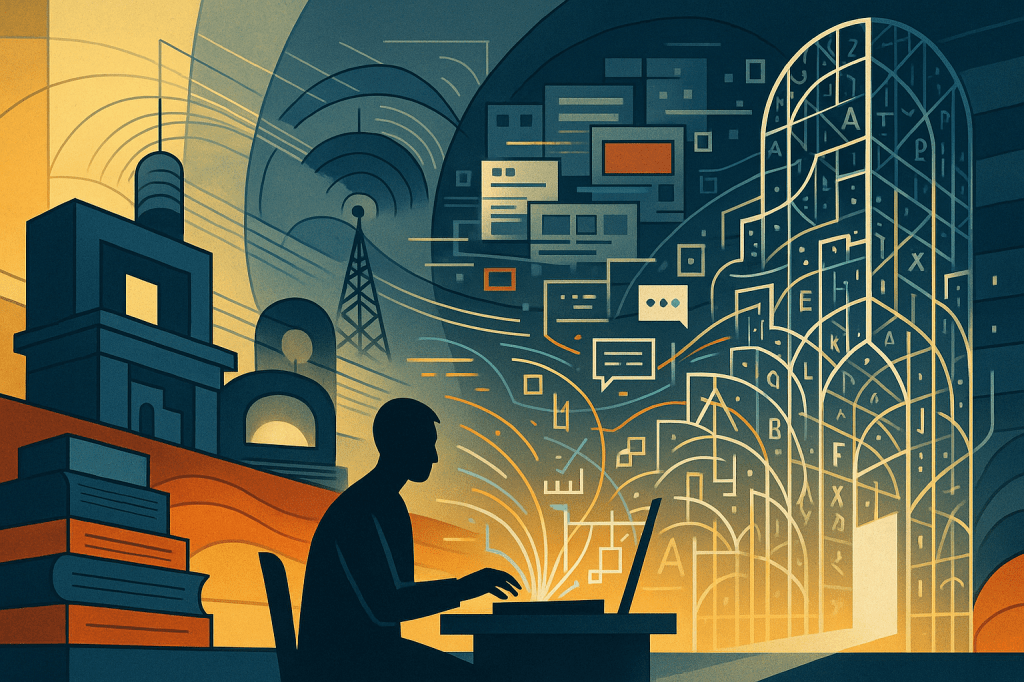
For the first time, anyone with a keyboard can reach for capacities once reserved for editors, translators, designers, and analysts. A single prompt can summon a draft, a translation, a sketch, or a conceptual scaffold. It feels almost like sorcery—though sorcery that still expects coherent instructions. Tasks that once demanded training are suddenly available to those of us who once struggled to format an AOL profile without breaking something.
But the hopeful story is only half the story.
AI does not automatically produce clarity; it produces whatever the user is capable of asking for. Vague prompts yield vague answers. Confusing questions return confident nonsense. Bias enters quietly and exits triumphantly. AI does not fix our misunderstandings; it accelerates them. It does not transcend human language; it depends on it.
Which means the promise of this revolution still rests squarely on us.
To use AI well, individuals must possess communicative literacy: the ability to articulate intentions, interrogate assumptions, and draw meaning from complexity rather than noise. Without these skills, AI becomes decorative confusion. Like every communications revolution before it, this one rewards those who wield language with care and punishes those who do not.
Yet the potential is enormous. People who have never published a line can now craft explanations. Those excluded by dominant languages can cross borders without losing nuance. Creativity once fenced off by expertise now spills outward into the digital commons. AI has—cautiously, conditionally—cracked open the gate.
But to understand where that gate leads, we must treat AI not as a machine, but as a medium: co-author, translator, amplifier, and occasionally distorting mirror.
Ahead lies the tension at the heart of our digital world. But before we step into it, we must understand what AI makes possible: the broadening of voice, agency, and narrative.
“AI does not automatically produce clarity; it produces whatever the user is capable of asking for.“
II: The New Democratic Possibility of AI
It’s tempting to remember the early internet with misplaced fondness—the era of blinking GIFs and websites that resembled ransom notes. Yet beneath the chaos was a strange, anarchic freedom: anyone could speak, even if most of us weren’t entirely sure what we were saying. AI revives that participatory energy, but with far more sophisticated tools than the ones we nearly broke on GeoCities.
AI widens the doorway. A student who struggled to assemble a paragraph can now express their ideas without wrestling their software. A multilingual speaker no longer has to choose between nuance and intelligibility. A scientist can translate complexity without sanding off meaning. AI does not just democratize tasks—it democratizes confidence.
Independent creators embody this shift. With nothing but a laptop, someone can run a research newsletter that resembles institutional output—only with clearer prose and fewer legal disclaimers. Communities can preserve local histories without waiting for cultural funding that may never appear. A linguist can document a fading language without needing an official grant or permission slip.
Language itself begins to stretch. English, long the world’s unofficial hall monitor, starts losing its monopoly. AI-driven translation invites more people to speak from wherever they stand. A debate in Polish or a poem in Tamil can enter the global conversation without changing its accent.
The cultural implications are unmistakable. Public discourse grows richer, stranger, more polyphonic. For a moment, the internet looks as if it might rediscover its original promise: a messy, vibrant commons rather than a corporate mall with Wi-Fi.
But optimism has edges. Even as AI opens expressive doors, the architecture behind those doors remains narrow, centralized, and quietly prescriptive.
And that paradox is where we now turn.
AI does not just democratize tasks—it democratizes confidence.
III: The Paradox of Digital Centralization
For all the talk of democratized expression, most of our communication runs through platforms that behave less like public squares and more like narrow hallways with a very selective doorman. Their interfaces suggest openness, but beneath the surface lies a quiet calculus that determines what rises, what sinks, and what never appears at all.
This is the paradox of our era:

We are freer to speak than ever, yet less certain that anyone—beyond an algorithm evaluating our usefulness—will hear us.
Silos have become the architecture of public life. They centralize attention with silent efficiency, ushering certain content forward while letting the rest evaporate. What feels like infinite reach is often just a hallway decorated with mirrors.
AI sits squarely within this architecture. The same corporations that shape our digital experiences also train and mediate the models we rely on. Left unexamined, AI simply automates their habits: rewarding the predictable, sidelining the unconventional, flattening the strange. An echo chamber does not become less of an echo chamber because it can now generate its own essays.
The danger is subtle: expression proliferates while perspectives converge. Creators multiply, but audiences fracture into algorithmically curated pockets. Activity accelerates, but autonomy thins.
Worse, most people mistake the feed for a window rather than a personalized hallucination. Convenience masquerades as transparency. Personalization poses as relevance.
Here, the light dims.
If AI relies on systems that narrow discourse, its democratizing potential is limited by design.
And if users lack the literacy to interrogate these systems, the promise dissolves before it arrives.
The revolution is real.
So is the containment.
To find a path forward, we look to those who resist platform gravity: the independent creators who insist on being human in a world that prefers predictability.
“What feels like infinite reach is often just a hallway decorated with mirrors.“
IV: The Counter-force of Independent Creators
Independent creators form a loose but persistent constellation resisting digital homogenization. They write newsletters, podcasts, research notes, community archives—built from spare rooms, browser tabs, and hosting plans designed by people who have never met a predictable billing cycle. Their unifying trait is not ideology but instinct: a refusal to hand culture over to the logic of optimization.
Their work introduces friction, texture, and occasionally delightful disorder. Algorithms struggle with it, which is partly the point. They publish essays that give recommendation engines indigestion and produce commentary that wanders off the neat paths platforms prefer. Their work is not engineered for virality; most viral content behaves like digital pollen—everywhere, carrying very little weight.
AI, used well, amplifies their independence. A writer can investigate with the reach of a small newsroom. A linguist can preserve a community’s language. A teacher can create tools built for actual learners instead of fictional “user personas.”
More importantly, these creators model another digital ethos. They show that the internet need not resemble an airport terminal: polished, surveilled, efficient, and faintly exhausting. It can be intimate, eccentric, porous—a place where communities gather for reasons more meaningful than algorithmic nudges.

Still, independence is fragile without communicative competence. Expression without clarity becomes noise. Even rebels need grammar.
And so the emotional tone brightens—not with naïveté, but with recognition: behind every independent creator stands someone who taught them how to think, how to question, how to interpret, how to communicate.
The quiet architects of the future are not technologists.
They are educators.
And it is to them that we now turn.
“They publish essays that give recommendation engines indigestion”
V: The Hidden Keystone: Language Educators
For all the attention lavished on AI, platforms, and algorithms, the most important force shaping our future is neither new nor particularly glamorous. It is human, quiet, and centuries old:
language educators.
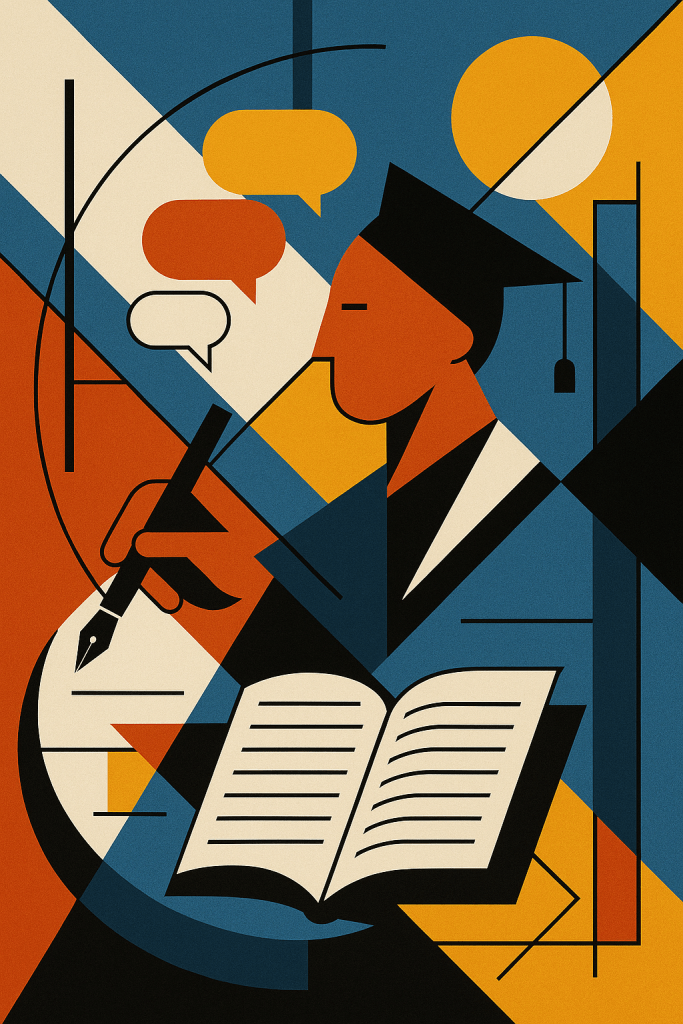
Their work becomes structural in the age of AI. They cultivate the skills the technology depends on—clarity, nuance, precision, curiosity, ethical intent. Without these, AI improvises. Users who cannot guide it are guided by it. Those who cannot interrogate its outputs simply accept them. Typing into a prompt is easy; asking a coherent question remains an Olympic event.
AI doesn’t replace educators; it magnifies their relevance.
To use AI well is to understand how meaning is constructed, how context shapes interpretation, how ambiguity alters outcomes, and how bias creeps into supposedly neutral phrasing. These are not technical skills; they are linguistic, rhetorical, interpretive.
Educators teach the architecture of thought.
In a world where information moves faster than verification and AI can hallucinate with perfect grammar, journalistic integrity and digital literacy become civic safety measures. Educators teach the questions that slow misinformation:
What is the source?
Who benefits from this version?
What assumptions am I bringing?
A few well-placed questions can stop an entire cascade of machine-speed errors.
They also preserve the virtues digital systems erode—complexity, patience, the ability to tolerate ambiguity. AI can amplify these virtues, but it cannot invent them.
Most importantly, educators ensure communicative power does not become a privilege of the already-advantaged. If AI is a megaphone, they teach people how to speak into it—and how to interpret what it shouts back.
This is the quiet truth beneath the spectacle:
the future of AI is a question of education, not engineering.
Everything returns to language.
Educators are the unacknowledged engineers of human–AI collaboration.
With the keystone set, a final question emerges:
What will we choose to build with it?
“AI doesn’t replace educators; it magnifies their relevance.”
VI: Toward a Communicatively Literate Future
As the dust settles, one fact becomes clear: AI has expanded expression, independent creators have enriched the digital commons, and educators have provided the foundation that makes both possible. Yet without communicative literacy—clear thinking, responsible writing, rigorous questioning, ethical interpretation—this progress collapses back into noise.
The truth arrives with quiet force:
AI expands possibility; language determines reality.
A society that cannot use language well cannot use AI well. It will amplify confusion, accelerate misinformation, and reinforce existing constraints. But a society grounded in literacy—linguistic, rhetorical, digital—can bend AI toward empowerment rather than containment. The decisive variable is human skill.

Education, then, becomes less a system and more a civic practice. We must teach people to write with intention, read with skepticism, speak with clarity, and listen with discernment. Communication is not merely self-expression—it is infrastructure. Prompting is not magic—it is writing with faster consequences.
Democracy depends on these skills: deliberation, disagreement, understanding. AI may assist, but it cannot replace the responsibility these acts require.
To build a healthy digital society, communicative literacy must be treated as a civic skill, not an academic elective. The future rests not on circuits or datasets, but on our capacity for meaning.
Because AI is not the author of what comes next.
It is the instrument through which our choices will be articulated.
And the quality of those choices—ethical, clear, diverse, deep—depends entirely on us.
AI opens the door.
Society decides who walks through it.
Educators ensure we can speak once we arrive.
The rest will be written—sentence by sentence—in the way we teach, question, create, and communicate.
The scaffolding stands.
The tools are in our hands.
What comes next is ours to articulate.
Ian Baker ©2025 All Rights Reserved





 kiloblitz.net